
CONTEXT
Understanding quantum communication
The field of quantum technologies encompasses several areas currently under development: computing, simulation, sensors, and communications.
Among these, quantum communication holds a special place. It does not aim to replace existing systems, but to strengthen a critical element of any digital infrastructure: the security of data exchanges.
A simple definition
Quantum communication involves using the properties of quantum physics — particularly those of photons — to transmit information securely.
Unlike conventional communications, it is not based solely on mathematical encryption methods, but on physical principles. This profoundly changes the way we think about security.
What quantum communication actually entails
Quantum communication is not limited to a single technology. It comprises several complementary building blocks:
Quantum key distribution (QKD)
This is currently the most mature application.
It enables two parties to generate and share an encryption key securely. Any attempt to intercept the signal disrupts the quantum signal and can be detected.
This key can then be used with conventional encryption systems.
Quantum networks
Beyond a point-to-point link, the challenge is to build fully-fledged networks capable of:
- connecting multiple users
- extending communication distances
- integrating mechanisms such as trusted nodes or, eventually, quantum repeaters
These networks constitute a new layer of infrastructure, complementary to existing telecoms networks.
Integration with conventional networks
Quantum communication does not operate in isolation.
It relies on current infrastructure — notably fibre optics — and integrates with conventional telecommunications networks (IP, 5G, etc.). This is referred to as hybrid architectures, where conventional and quantum data streams coexist.
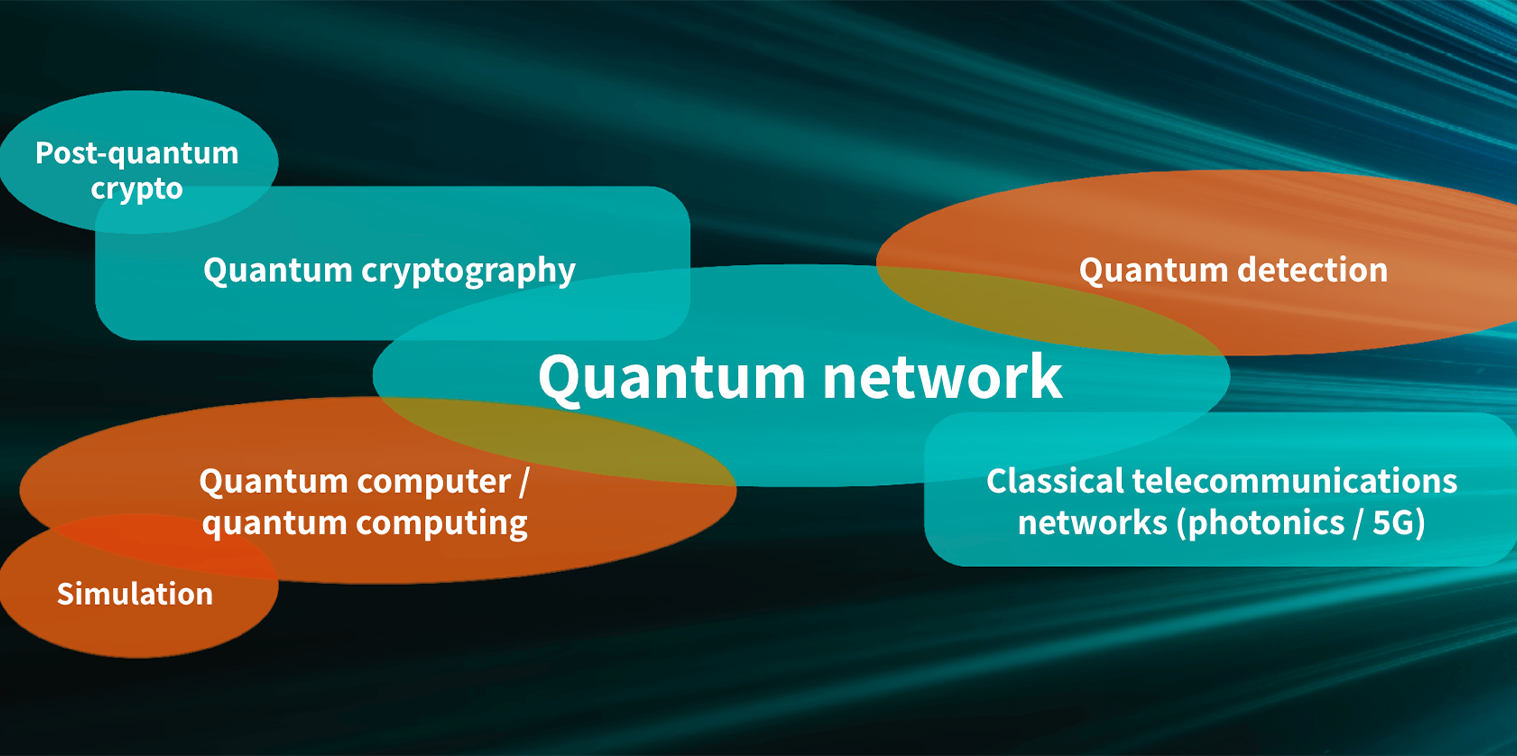
Where does quantum communication fit into the ecosystem?
Quantum technologies are often presented as a coherent whole, but their applications vary.
- Quantum computing aims to solve complex problems (optimisation, simulation, cryptanalysis).
- Quantum sensors enable ultra-precise measurements (time, gravity, magnetic fields).
- Quantum communication, for its part, focuses on securing data exchanges.
It acts as a layer of trust between these different systems and, more broadly, within digital infrastructures.
In other words, where quantum computing may introduce new vulnerabilities, quantum communication helps to address them.
A complementary technology, not a competing one
It is important to clarify one point: quantum communication does not replace existing technologies.
It complements them.
In practice:
- current networks continue to carry data
- encryption methods are evolving (notably with post-quantum cryptography)
- quantum communication adds an extra layer of security for sensitive data exchanges
This gradual approach allows for realistic adoption, without disrupting existing systems.
Even though some components are still being rolled out, the challenges are already very real:
- the need to secure data in the long term
- increasing regulatory requirements
- and heightened exposure to risks associated with future quantum computing capabilities
In this context, quantum communication offers a targeted solution for use cases where the highest level of trust is required.
One of the current challenges is moving from theoretical understanding to operational validation.
Testing quantum communication under real-world conditions enables:
- assessing its integration into existing networks
- measuring its performance
- identifying relevant use cases
It is with this in mind that open testing infrastructures are being developed, enabling organisations to explore these technologies before their wider adoption.
Quantum communication does not represent a sudden disruption, but rather an evolution of communication architectures.
In the short term, it is being integrated into hybrid approaches.
In the medium term, it is helping to build more secure networks.
In the long term, it could become a standard component of critical infrastructure.
For organisations, the challenge is less technological than strategic: understanding where this building block can add value, and when to integrate it.

Ready to start your project?
Kirq offers support tailored to your objectives, your project and its maturity.
Contact our team today to get started and discuss your requirements.
If you’d like to submit a use case, please get in touch.